
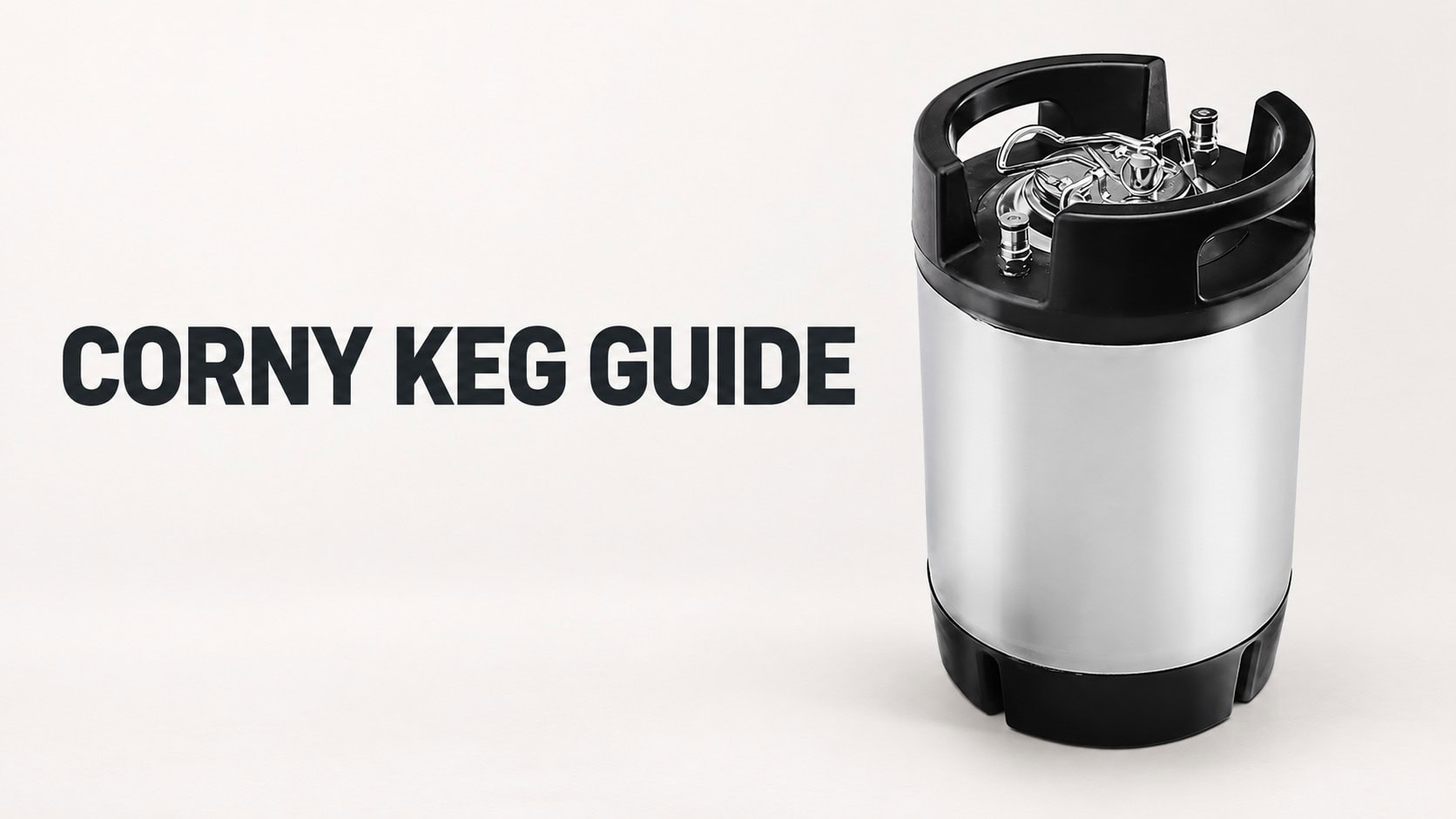
A corny keg gives you a practical way to store, carbonate, and dispense small batches of beer or other beverages. This guide explains the essential parts, common sizes, connector types, and buying checks you need before choosing one.
What Is a Corny Keg?
A corny keg, also called a Cornelius keg, is a reusable stainless steel container originally developed for carbonated soft drinks. Homebrewers later adopted it for beer because it is compact, serviceable, and easy to open.
Unlike many commercial beer kegs, it has a removable lid and separate gas-in and liquid-out posts. This layout gives you direct access to the interior and lets you connect gas and beverage lines independently.
Corny Keg Parts and Their Jobs
A Cornelius keg has relatively few components, but every one affects sealing, cleaning, and dispensing. Understanding the basic layout makes it easier to inspect a keg and order compatible replacement parts.
| Part | What It Does | What to Check |
| Keg body | Holds the beverage under pressure | Dents, corrosion, interior condition, and marked specifications |
| Lid and lid O-ring | Close and seal the main opening | Correct fit, clean sealing surfaces, and sound rubber |
| Pressure relief valve | Allows controlled pressure release | Correct model, clean operation, and an undamaged seal |
| Gas post | Connects the regulated gas supply | Matching disconnect, poppet, thread, and O-ring |
| Liquid post | Connects the beverage line | Matching disconnect, poppet, thread, and O-ring |
| Dip tubes | Carry gas into the headspace and beverage out | Clean bore, correct position, and no damage |
Corny keg parts are not universally interchangeable. Post threads, poppets, lids, and seals may vary between manufacturers and older keg families. Check the keg model before purchasing a rebuild kit.
When choosing corny keg connectors, match each disconnect to the post family, line size, and preferred barb or threaded connection.
Ball Lock vs Pin Lock Corny Kegs
Ball lock and pin lock describe how quick disconnects attach to the gas and liquid posts. Both systems perform the same basic jobs, but their fittings do not connect to each other.
| Feature | Ball Lock Corny Keg | Pin Lock Corny Keg |
| Connection | Disconnect locks around a grooved post | Disconnect engages pins on the post |
| Typical shape | Often taller and narrower | Often shorter and wider |
| Identification | Gas and liquid posts use different profiles | Gas and liquid posts use different pin patterns |
| Best fit | Buyers building a widely supported new setup | Buyers who already own compatible pin lock equipment |
A ball lock keg is often the simpler starting point when you are building a new system. However, an existing collection of pin lock disconnects and spare parts may make pin lock the more economical choice.
Common Corny Keg Sizes
Corny keg size affects batch volume, handling weight, refrigerator fit, and cleaning access. Common nominal capacities include small portable formats, 2.5-gallon and 3-gallon models, and the familiar 5-gallon corny keg.
| Nominal Size | Approximate Metric Volume | Typical Use |
| 1–1.5 gallons | About 4–6 liters | Samples, test batches, and portable serving |
| 2.5 gallons | About 9.5 liters | Split batches and compact cold storage |
| 3 gallons | About 11.4 liters | Small batches and limited-height spaces |
| 5 gallons | About 19 liters | Standard homebrew batches and regular draft use |
These are nominal capacities, not universal dimensions. Handles, bases, lids, and post styles change the overall height and diameter. Measure the actual keg rather than relying on capacity alone.
Corny keg dimensions can vary even at the same nominal capacity, especially between different manufacturers and handle designs.
Remember to leave space above the keg for disconnects, hoses, and lid access. Also check the refrigerator floor, compressor hump, door shelves, and planned CO2 cylinder position.
How to Choose the Right Cornelius Keg
Start with your beverage volume and available cold-storage space. Then review the entire system, because a good keg is only useful when its fittings, regulator, lines, and tap work together.
- Choose the capacity: Match the keg to your usual batch size and the amount you can realistically keep cold.
- Confirm the connector family: Select ball lock or pin lock before buying disconnects, posts, or spare parts.
- Measure the space: Check height, diameter, handle clearance, hose routing, and access for lifting the keg.
- Review the markings: Look for clear material, capacity, manufacturer, and pressure information appropriate to your application.
- Inspect the finish: Check the interior, weld areas, rim, posts, base, and handles for damage or contamination.
- Plan maintenance: Make sure compatible O-rings, poppets, lids, dip tubes, and disconnects are available.
For wholesale or customized orders, request a complete specification sheet and approved sample. Confirm capacity tolerances, dimensions, fittings, surface finish, testing, packaging, and logo requirements before production.
Setup, Cleaning, and Leak Checks
Even a new corny keg should be inspected and cleaned before use. Follow the supplier’s instructions and use cleaning and sanitizing products that are compatible with stainless steel and your seals.
- Confirm the keg is fully depressurized before opening or removing any component.
- Inspect the body, lid, posts, dip tubes, poppets, pressure relief valve, and O-rings.
- Clean each product-contact surface, rinse thoroughly, and sanitize before filling.
- Reassemble the correct parts and apply only a suitable food-contact lubricant where required.
- Connect the regulated gas line to the gas post and the beverage line to the liquid post.
- Perform a leak check within the keg manufacturer’s stated operating limits.
Never exceed the marked working pressure or bypass a safety device. Depressurize the keg before servicing posts, lids, valves, or dip tubes, even when the pressure gauge appears low.
FAQs about Corny Kegs
What is the difference between a corny keg and a Cornelius keg?
There is no practical difference. “Corny keg” is the common shortened name for a Cornelius-style keg with a removable lid and separate gas and liquid connections.
Should I choose a ball lock or pin lock keg?
Choose the system that matches your existing equipment. For a new setup, ball lock is often easier to standardize because compatible disconnects and accessories are widely available.
What is the most common corny keg size?
The 5-gallon corny keg, approximately 19 liters, is a common choice for homebrewing. Smaller models suit split batches, samples, portable systems, and limited refrigerator space.
Can I use one disconnect on both posts?
No. Gas and liquid disconnects have different functions and normally use distinct fittings. Match each disconnect to the correct post and never force an incompatible connection.
How do I know whether a corny keg will fit my kegerator?
Measure the exact keg and your usable interior space. Include clearance for disconnects, hose bends, the lid, the refrigerator door, and any compressor hump.
What should I replace on a used corny keg?
Begin by inspecting all seals, poppets, posts, dip tubes, the lid, and the relief valve. Replace worn parts with components confirmed for that keg model.
At Ningbo Kegstorm, we manufacture stainless steel beverage packaging and tapping solutions, including Cornelius kegs and related accessories. Explore our Cornelius keg range, or contact us to discuss fittings, capacity, and OEM requirements.