
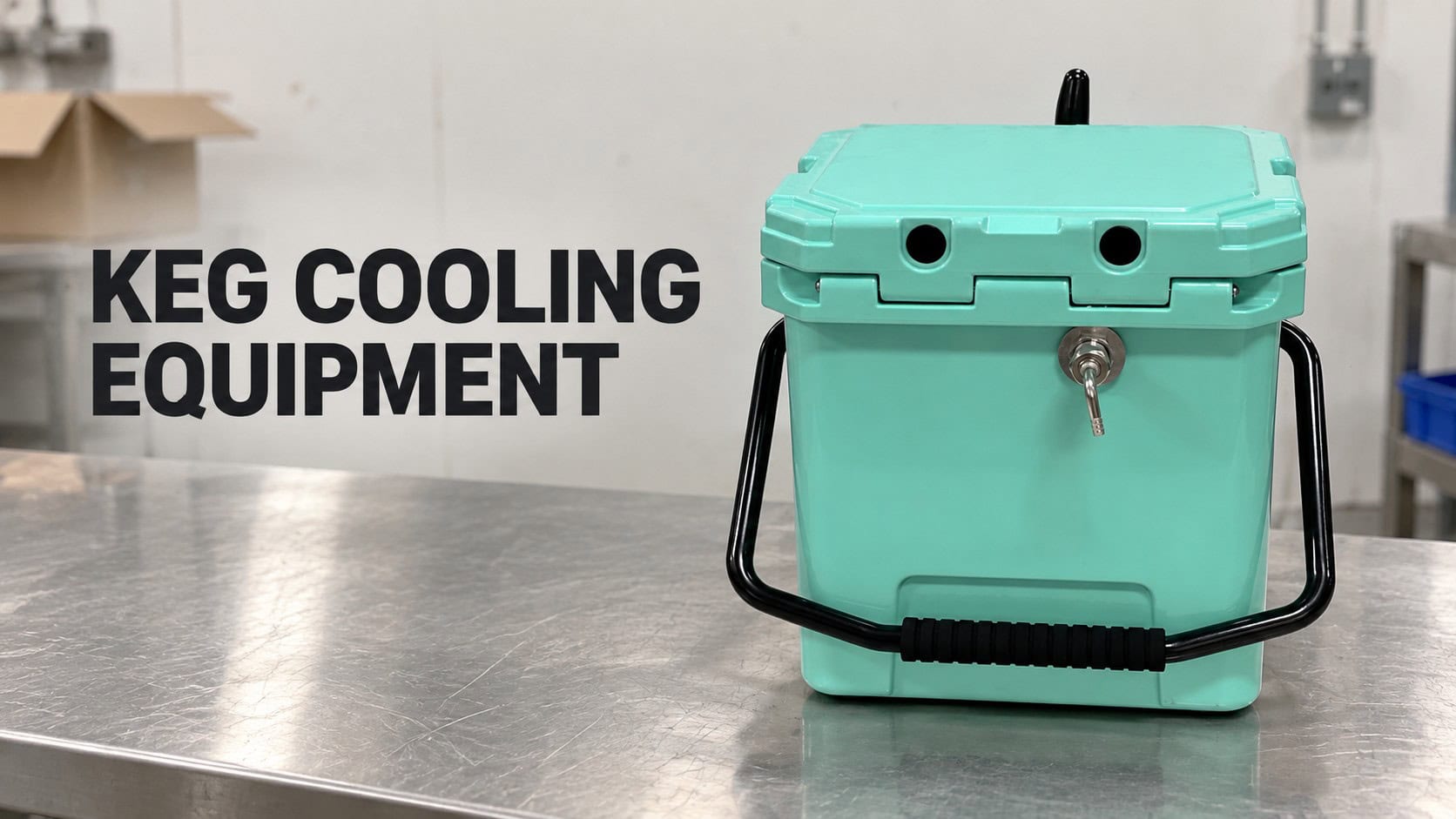
For commercial beverage projects, cooling equipment must match the venue, serving rate, logistics, and sales channel. This article helps distributors, bar-equipment buyers, event companies, and OEM teams compare keg cooler formats before placing an order.
What Counts as Keg Cooling Equipment?
Keg cooling equipment covers more than one product type. It may include an insulated container, a portable draft cooler, a refrigerated keg cabinet, or a complete dispense system with taps and lines.
In a B2B quotation, define the product by its operating job rather than by a vague label. Does it store a pre-chilled keg, cool beverage as it is poured, or continuously refrigerate several kegs?
This distinction affects the tank or box design, insulation, cooling method, fittings, packaging, and after-sales support your customers will expect.
Jockey Box, Portable Keg Cooler, or Kegerator?
| Format | How it cools | Best commercial fit |
| Jockey box | Ice chills beverage through an internal coil or cold plate | Events, mobile bars, catering, and rental fleets |
| Portable keg cooler | Insulation and ice or cold packs slow heat gain around a keg | Transport, outdoor service, and temporary dispensing |
| Refrigerated keg cooler | Powered refrigeration keeps kegs cold in a cabinet | Bars, restaurants, taprooms, and permanent installations |
A jockey box is a specific portable draft format: an insulated cooler body is fitted with beverage coils or a cold plate and one or more faucets. Beer or another kegged beverage is chilled while it travels to the tap.
Keg cooler is a broader commercial term. Some buyers mean a portable insulated box, while others mean a powered cabinet. Clarify the intended meaning in product listings, technical drawings, and purchase contracts.
Match the Cooling Method to the Venue
Temporary and Mobile Service
Event operators and caterers often need a system that can be loaded into a vehicle, set up quickly, and operate where electricity is limited. A jockey box or insulated keg cooler can be more practical than a fixed refrigeration cabinet.
For rental fleets, inspect handles, corner protection, drain access, tap protection, and replacement parts. Equipment may be moved repeatedly by different crews, so serviceability matters as much as appearance.
Bars and Permanent Beverage Service
Bars, hotels, restaurants, and taprooms usually prioritize stable temperature, tap count, internal capacity, and easy access for cleaning. A refrigerated keg cooler or kegerator is typically considered when the unit will remain connected in one location.
Ask about power requirements, ventilation clearance, door or lid layout, line routing, and compatibility with the customer’s keg couplers. These details can determine whether an apparently suitable unit fits the installation.
Specification Priorities for Wholesale Buyers
When comparing suppliers, separate the core cooling body from the dispensing package. A quotation should identify what is included and what must be sourced locally.
- Usable internal volume and supported keg formats
- Insulation type, wall construction, and lid or door seal
- Cooling method: ice, cold plate, coil, compressor, or another system
- Number and position of taps, shanks, and drip trays
- Keg coupler, gas line, beverage line, and connector standards
- Drainage, cleaning access, and replaceable wear parts
- Carton dimensions, palletization, and transport protection
Do not compare capacity by the outside dimensions alone. Usable space can be reduced by coils, cold plates, fittings, internal dividers, or clearance needed for a keg handle and coupler.
OEM and Private-Label Considerations
OEM projects require agreement on more than a logo. Define the product architecture, target market, operating environment, and service model before approving a sample.
Useful discussion points include:
- Insulated cooler body, stainless components, or a combined construction
- One-tap or multi-tap configuration
- Local connector standards and replacement-part availability
- Color, handle, lid, drain, label, and packaging requirements
- Assembly level: cooler body only, kit, or ready-to-serve system
- Inspection plan for sealing, cooling, dispensing, and appearance
Request drawings or a controlled specification for every customized part. This reduces variation between samples and production units and gives your sales, quality, and service teams one reference document.
How to Evaluate a Keg Cooling Supplier
A low unit price does not show the full cost of a commercial cooling program. Evaluate the supplier’s engineering communication, consistency, packaging, documentation, and ability to support repeat orders.
- Send the supplier your target beverage, keg formats, tap count, and venue.
- Request a complete bill of materials and technical specification.
- Check the sample for fit, finish, insulation, line routing, and cleaning access.
- Confirm packaging dimensions, labeling, spare parts, and inspection records.
- Approve a golden sample before starting regular production.
For international orders, also confirm export cartons, pallet loading, manuals, language requirements, and the process for handling damaged or missing components.
Design for Reliable Service and Maintenance
Commercial users value equipment that can be cleaned and returned to service quickly. Beverage-contact lines, coils, cold plates, taps, couplers, and seals should be accessible without unnecessary disassembly.
Build maintenance expectations into the product brief. Specify flushing, sanitizing, drying, storage, and replacement procedures. If your channel sells rental equipment, provide a simple inspection checklist that staff can follow between events.
Cooling performance also depends on the complete draft system. A well-insulated box cannot correct an unsuitable keg temperature, unbalanced line, blocked connector, or poorly maintained faucet.
FAQs about Keg Cooling Equipment
Is a jockey box the same as a keg cooler?
Not exactly. A jockey box is one type of portable keg cooling and dispensing system. Keg cooler is a broader category that may include insulated boxes, mobile coolers with taps, and powered refrigerated cabinets.
Which system is better for event rental companies?
Many rental operators start with portable jockey box systems because they are movable and do not require a permanent electrical installation. The right choice depends on expected serving rate, ice logistics, tap count, transport, and cleaning workflow.
What should a wholesale quotation include?
List the cooling body, keg capacity, taps, coils or cold plate, couplers, gas and beverage lines, drip tray, fittings, packaging, manuals, spare parts, and inspection requirements. Clarify which items are optional.
Can keg cooling equipment be customized?
Many systems can be adapted for tap count, dimensions, handles, colors, fittings, packaging, and private labeling. Confirm feasibility with drawings and a production sample before approving an OEM order.
How do I choose between ice cooling and powered refrigeration?
Choose ice-based cooling for temporary, mobile, or low-infrastructure service. Choose powered refrigeration for fixed venues that need continuous storage and repeatable temperature control. Some operations use both formats for different channels.
Kegstorm manufactures stainless steel kegs and beverage dispensing equipment for commercial buyers, with OEM and ODM support for defined projects. Review our product range, or contact us with your keg format, cooling method, tap configuration, and packaging requirements.